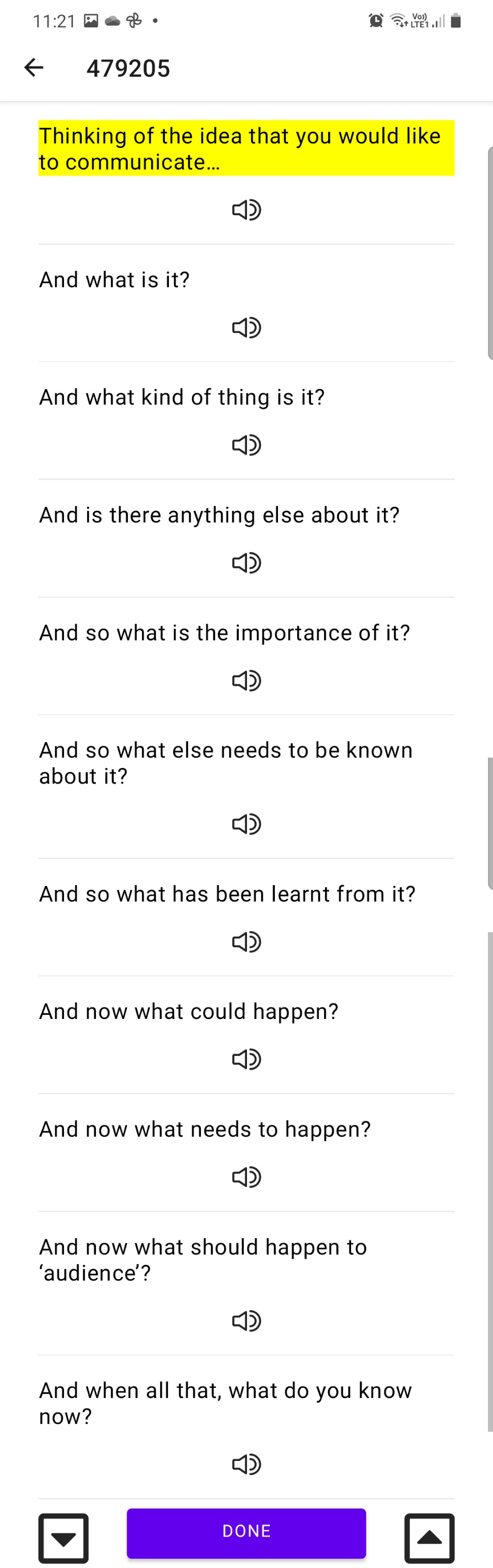
Use Clean Sequence 479205 (Borton Development Framework) when you are reflecting on an event or experience
Here's a 440-word article...then I show you how it emerged from Clean Sequence 479205.

A useful framework for reflecting on an idea, an event or an experience is Terry Borton’s Development Framework. First presented in 1970, it focuses three areas: ‘What?’, ‘So What?’ and ‘Now What?’. I’ve written Clean Sequence 479205 to cover those same areas.
I used that Sequence to write this article. So here goes…
What?
This is where I cover what has happened. Well, I used Clean Sequence 479205 to write a draft of this article. Then I edited it so it’d make more sense. As I did this, I noticed that I felt a little anxious that you, my readers, would not be interested in my reflections about drafting this article.
So What?
It struck me that this anxiety relates to whether I’m trying to write:
useful content for me, allowing me to get things off my chest and feel better from articulating half-formed thoughts that would otherwise take up valuable storage space in my mind? or
useful content for you, laden with takeaways and value?
Now what?
If I’m writing for me, I could use Clean Sequence 479205 a lot as a scaffold for drafting articles. If I’m writing for you, I should maybe use it just in my pre-writing phase.
Hmm. I think I should use it for pre-writing. That’s a useful clarification for me.
Having said that, maybe I could use the Sequence when I’m talking about difficult issues where there’s no clear answer, and maybe when I’d like to inject some variety in the pace in a book. That’s sometimes a good idea: just as a long piece of music sometimes changes tempo to make it more interesting, so a long piece of writing can too.
Overall I’m happy to keep the Sequence as a tool in my toolbox, ready to bring out when needed, but it might lurk near the bottom of the toolbox due to being used less frequently than some other tools.
*
So that’s the end of my reflection. Maybe it’s been just enough to prompt your curiosity. If so, you might like to check out this article about ‘what, so what, now what’:
Smith, S., James, A., Brogan, A., Adamson, E. and Gentleman, M. (2016) Reflections about experiences of compassionate care from award winning undergraduate nurses – What, so what … now what?, Journal of Compassionate Health Care, 3(6), [online] Available from: https://tinyurl.com/y6kb288f
To sum up, I think it’s worth trying out Clean Sequence 479205 especially if you have never used it before. It seems to be a workable way of gaining additional insights and also of feeling a creative rush – which is, for me at least, one of the main reasons why I want to be a writer.
<ends>
Now I’ll share how the content for that article emerged from a Clean Sequence (code = 479205). The questions posed by the Clean Sequence are in italics:
Thinking of the idea that you would like to communicate…
My draft subheading is: ‘Consider the Borton Development Framework when you are reflecting on an idea rather than trying to promote it’
And what is it?
I’d like to reflect on my experience of using Terry Borton’s Development Framework as a scaffold for writing.
And what kind of thing is it?
His framework is built around three questions: ‘What?’, ‘So What?’ and ‘Now What?’. First presented in 1970, it has a long pedigree as a logical way to reflect on an idea, an event or an experience.
And is there anything else about it?
What happened when I used Borton’s framework to write? The first time I used it, I felt a little uncomfortable: it encouraged me to reflect on what I thought and what I learnt (obviously) – this is rather different to the usual stance of advertising copywriters who are very concerned with what the audience think and what the audience might be learning. I began to worry that you, my readers, would not be interested in my reflections.
At the same time, I reminded myself that what I’m trying to achieve is to try out the framework. Perhaps, some of the time, it’s ok for readers to be part of my journey of reflection, rather than to be recipients of valuable nuggets that have been pre-made.
And so what is the importance of it?
This is an important point as it touches on what I’m trying to do as a writer. Am I writing a useful book for you, laden with takeaways and value, or is it a useful book for me, allowing me to get things off my chest and feel better from articulating half-formed thoughts that would otherwise take up valuable storage space in my mind?
And so what else needs to be known about it?
So what? Actually, this is a big deal. If you’re reading my stuff for value, I assume you don’t want too many of my reflections. If you’re reading my stuff because it’s interesting to hang out in my company as I work through some interesting questions, then you’ll probably want more of my writing to be based on Borton’s framework.
And so what has been learnt from it?
My sense is that most of my readers are looking for value. So what strikes me, as I reflect, is that Borton’s framework is not something that I will use all the time. It is most likely to be useful when I’m talking about difficult issues where there’s no clear answer, and maybe when I’d like to inject some variety in the pace in a book. That’s sometimes a good idea: just as a long piece of music sometimes changes tempo to make it more interesting, so a long piece of writing can too.
And now what could happen?
Personally, I’ve decided to keep Borton’s framework as a tool in my toolbox, ready to bring out when needed, but it might lurk near the bottom of the toolbox due to being used less frequently than some other tools.
And now what needs to happen?
Having said this, I definitely want it in the toolbox. It’s actually quite a fun scaffold to use. It’s always nice to be asked for my opinion on things and to be encouraged to write about my own reflections. Yes, I want it in the toolbox.
And now what should happen to ‘audience’?
As I reach the end of this section, and thinking of people who would like to know more, I’d like to suggest an academic article that touches on using ‘What? So What? Now What?’ questions:
Smith, S., James, A., Brogan, A., Adamson, E. and Gentleman, M. (2016) Reflections about experiences of compassionate care from award winning undergraduate nurses – What, so what … now what?, Journal of Compassionate Health Care, 3(6), [online] Available from: https://tinyurl.com/y6kb288f
And when all that, what do you know now?
To sum up, I think it’s worth trying out Borton’s framework especially if (like my beta readers) you have not done so before.
And what difference... does knowing that... make?
It’s potentially an additional way of gaining insights and feeling a creative rush – which is, for me at least, one of the main reasons why I want to be a writer.
Here’s a screen shot of Clean Sequence 479205 on the Android app: